
Evaluating the effects of seaweed sinking in the Caribbean (SeaSINC)
SeaSINC will address critical knowledge gaps in our understanding of the effects of sinking seaweed on deep marine environments and ecosystems by conducting the first controlled, small-scale pilot study in the Caribbean.
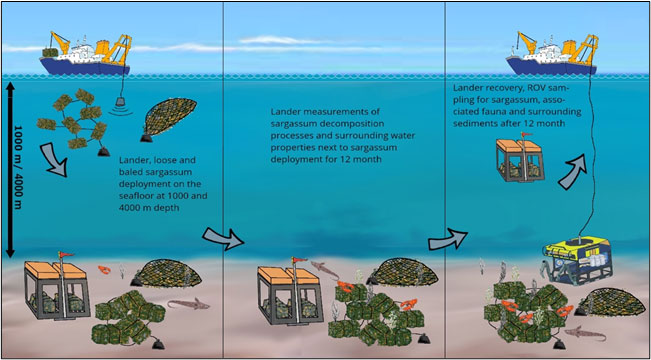
In doing so it will provide the information required to help decide if, where, and how the burial of seaweed in deep marine settings can be used to help tackle Sargassum related issues in the Caribbean and/or as a marine CDR approach in support of national, and global, climate mitigation requirements.
Sargassum is a free-floating seaweed found naturally throughout the Great Atlantic Sargassum Belt (GASB), which extends from West Africa to the Caribbean Sea and Gulf of Mexico. Although seasonal blooms within the GASB vary in size, the rafts can cover several thousand km2 and cause significant negative social, economic and ecological effects when washed up on shore. Disposal of these inundations of Sargassum represents a significant challenge for many Caribbean islands with limited land space, thus sinking in deep ocean settings is being considered by some countries as a means of managing the influxes and mitigating their adverse effects.
Sinking seaweed in deep marine environments is also one of the techniques currently being considered in marine Carbon Dioxide Removal (mCDR) portfolios. Like other marine photosynthetic organisms, seaweeds incorporate dissolved carbon from seawater into their tissue during growth, thus actively sinking the organic matter into deep marine environments can help remove that carbon from the near-surface reservoir where it may be re-exchanged with the atmosphere, potentially facilitating the burial of CO2 over timescales of hundreds to thousands of years. Although the CDR potential of seaweed sinking is currently projected to exceed 1Gt CO2 per year, the impacts and/or co-benefits of this approach on marine ecosystems remain highly uncertain, and little to no information is currently available to assess the scale or nature of any effects on deep ocean environments.
PI: Dr Christopher Pearce
Email: c.r.pearce at noc.ac.uk
Dates: December 2023 – ongoing
SeaSINC will address critical knowledge gaps in our understanding of the effects of sinking seaweed on deep marine environments and ecosystems by conducting the first controlled, small-scale pilot study in the Caribbean. Specifically, the project will establish if, and how, the deposition of sargassum onto the seafloor affects microbial, meio-, macro- and megafaunal communities and/or biogeochemical processes in the surrounding sediments and water column.
Data generated through this study will fundamentally improve our understanding of the rate of Sargassum seaweed decomposition in deep marine environments, and the extent to which it may affect biogeochemical processes and ecosystem functioning. In doing so the project will help inform and evaluate the viability of seaweed sinking as a mCDR strategy, as well as its associated benefits and consequences.